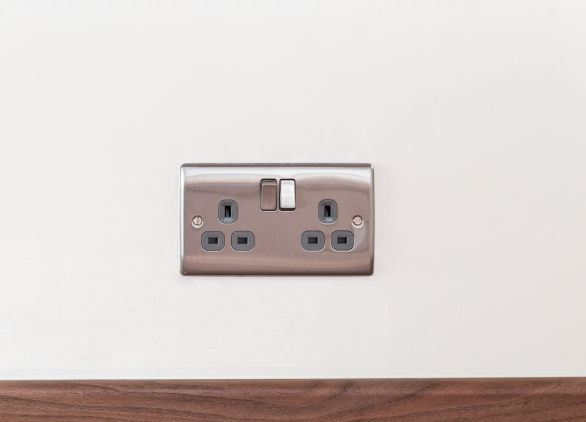

A few days ago, one of my long-standing customers in Maidenhead contacted me about a strange buzzing or humming noise coming from a downstairs socket.

He had noticed it while working on his laptop and using some other appliances. The difficult part was that the noise did not happen all the time. Intermittent electrical problems can be frustrating because everything may appear perfectly normal by the time an electrician arrives.
I was already busy that day, so I could not attend immediately, but I managed to visit the following day. It was nice to see the family again—including their lovely dog and their fairly newborn baby—but naturally, the priority was to investigate the socket and make sure it was safe.
The Initial Socket Test Looked Fine
I started with a basic plug-in socket tester. This is a useful first check because it can identify some common wiring faults, such as missing connections or incorrect polarity.
The tester indicated that everything was fine.
We then tried to recreate the conditions under which the customer had previously heard the noise. He plugged in the extension lead he normally used, along with the laptop and other equipment. At first, there was no obvious humming.
However, while moving the tester and operating the socket, I heard a very faint buzzing sound—almost like a tiny sparking or crackling noise. It was quiet and easy to miss, but this type of sound often suggests a poor or loose electrical connection.
A socket can continue working even when a connection behind it is no longer secure. That is why simply plugging in a tester is not always enough, particularly when the customer has already reported an unusual noise.
If you notice buzzing, crackling, excessive heat or a burning smell from a socket, switch off or unplug the appliance if it is safe to do so and contact a qualified electrician for advice.
The Fault Was Hidden Behind the Socket
To investigate properly, I switched off the electrical supply and safely removed the socket from the wall.
As soon as I opened it, the problem became clear. The neutral conductor was extremely loose and came straight out of its terminal. This was almost certainly the source of the intermittent buzzing and faint sparking noise.
I re-terminated the conductor, making sure it was correctly positioned and securely tightened. I also checked the other connections before carefully putting the socket back into place.
Once everything was reassembled, I restored the power and tested the socket again. The results were satisfactory, and the buzzing noise had disappeared.
Fortunately, the customer noticed the warning sign and contacted me before the loose connection developed into something more serious.
Why Can a Loose Connection Be Dangerous?
Electrical connections need to be secure so that current can pass through them properly. If a conductor becomes loose, the contact area may be reduced and electrical resistance can increase. This can generate heat at the terminal.
In some cases, a loose connection may also produce arcing—electricity jumping across a small gap. This can cause buzzing, crackling, discolouration, melting around the terminal or a burning smell. If it continues, there is a risk of damage to the socket, wiring or connected equipment, and potentially an electrical fire.
The noise may only occur when a particular appliance is operating or when the circuit is carrying a heavier load. That can explain why the customer heard it while using his laptop and other appliances, but why it was not constantly present during my visit.
Do Not Ignore Unusual Electrical Noises
Sockets and switches should normally operate silently. A faint buzzing sound might seem harmless, particularly if the socket is still working and no circuit breaker has tripped. However, protective devices do not necessarily disconnect the power immediately for every loose connection.
It is also important not to repeatedly plug appliances in and out to “see what happens” if a socket is crackling, visibly damaged or becoming hot. Avoid using it and arrange for it to be inspected.
This job was a good reminder that listening to the customer is just as important as using test equipment. The initial socket test appeared normal, but the customer knew the sound was unusual. A physical inspection behind the socket revealed the real fault.
What looked like a small and occasional annoyance turned out to be a loose neutral connection that needed prompt attention. Thankfully, it was found, repaired and tested before it caused further damage.
If you have a buzzing socket or another electrical concern in Maidenhead, Wokingham, Reading or the surrounding areas, contact IGT Electrical to arrange an inspection. It is always better to investigate a warning sign than to wait for it to become a larger problem.